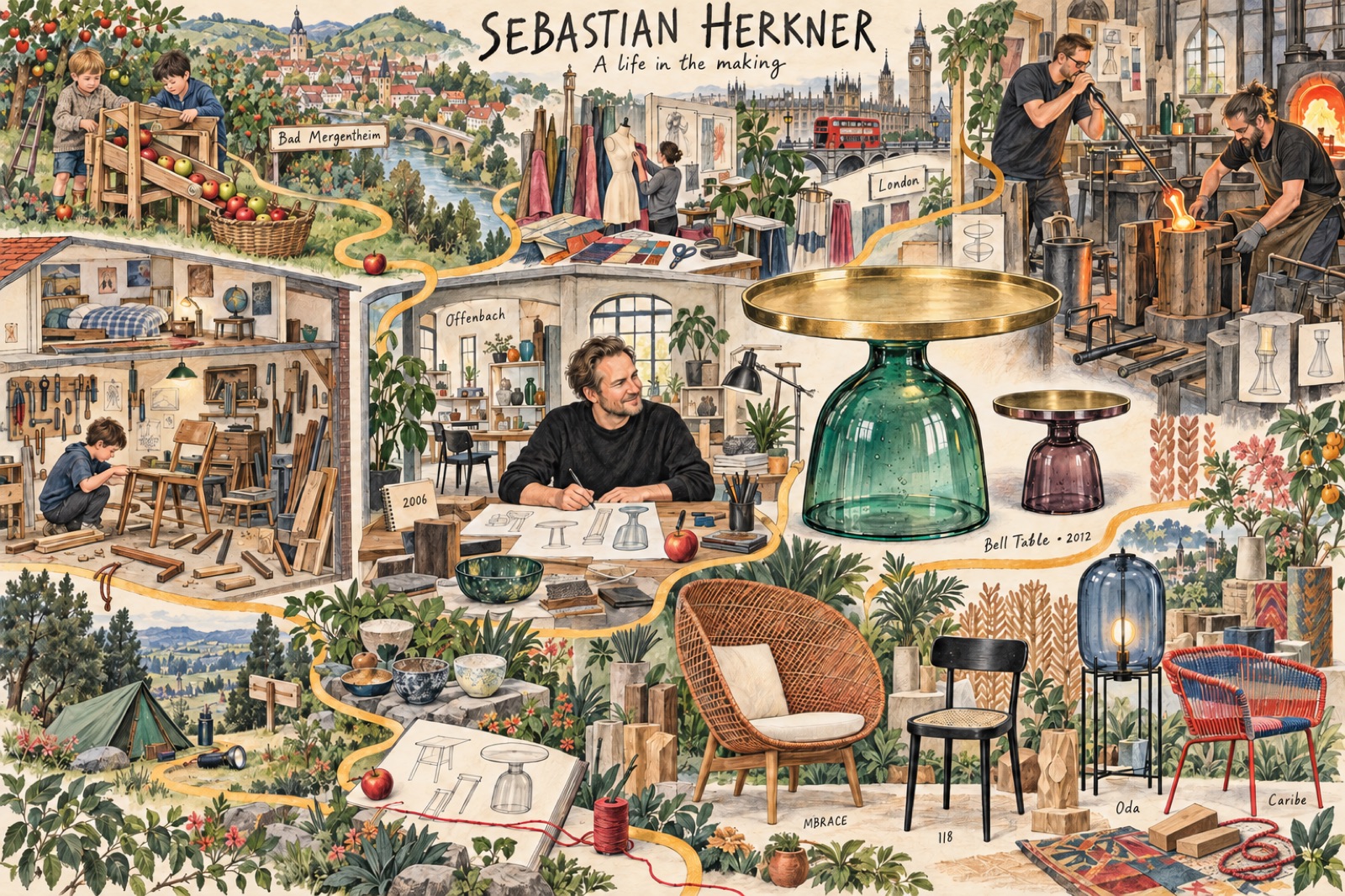
He got his start taking chairs apart in the room next to his bedroom. The table everyone knows began with a machine that did not work.
There is a shorthand version of Sebastian Herkner that gets passed around: the colour one, the craft one, the man who made that glass table. It is not wrong. It is the last third of the story told without the first two, and the first two are where the method comes from. The method is the actual contribution.
Bad Mergentheim, the town in the Tauber valley in southern Germany where Herkner was born in 1981, has around 24,000 residents today. It is a long way from Milan, London or Copenhagen, and the distance matters, because the early scene is practical rather than mythic. So how does the boy who spent his afternoons taking chairs apart end up with one of contemporary furniture's most recognisable tables?
The answer is not a single breakthrough. It begins with an apple sorter that failed.
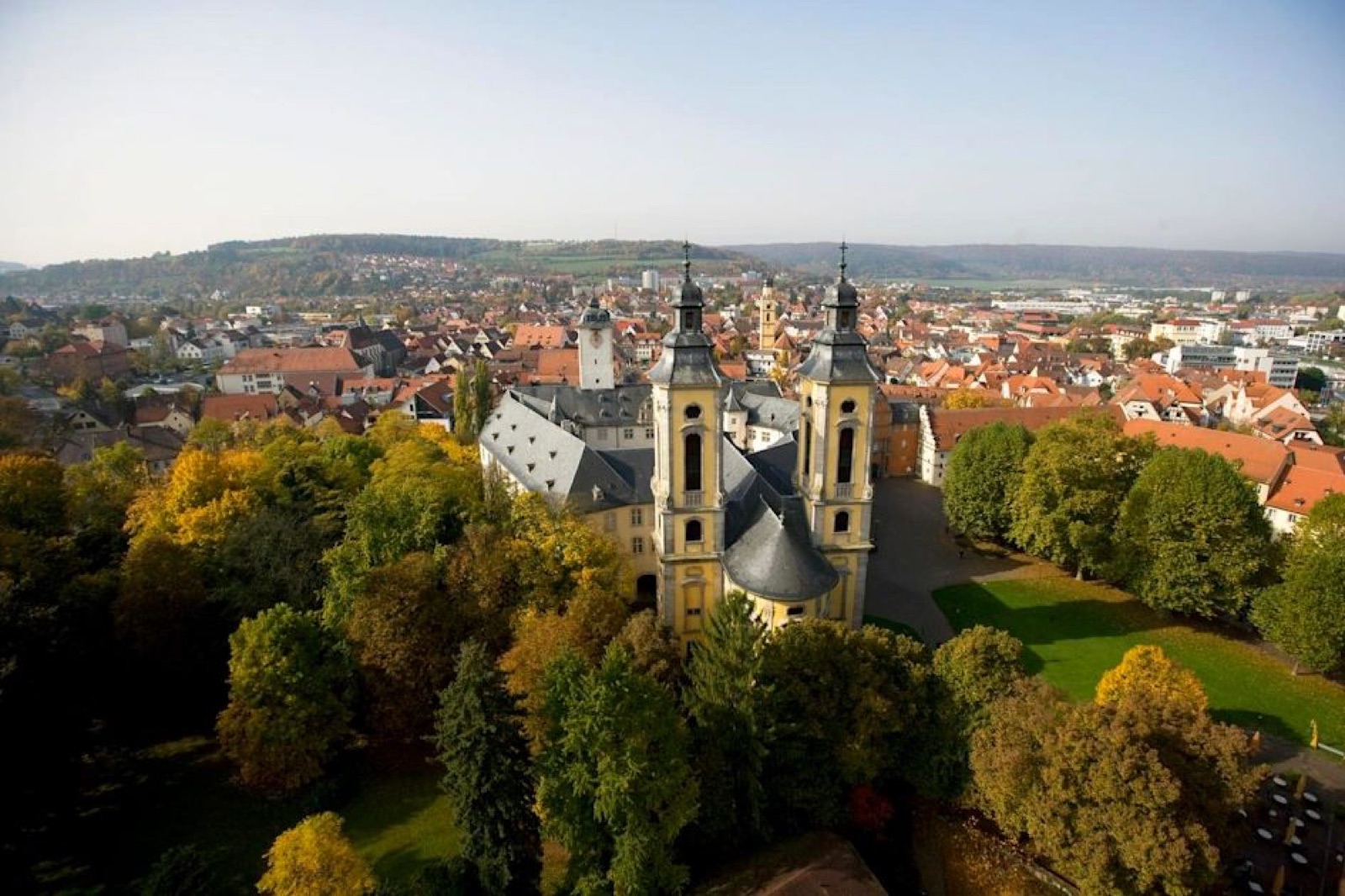
The room next door
His childhood bedroom was, by his own account, decorated in his parents' style. The room beside it was not. It became a private workshop where he drew, built things, repaired chairs and took furniture apart. Hold onto that, because it is the whole career in miniature: before he designed furniture, he was learning how furniture was put together.
The earliest project he remembers properly was built with his older brother in their grandparents' garden. It was a machine meant to sort apples by size, running them through channels and hoppers. It did not work.
The failure is worth more than the anecdote it usually gets reduced to. The question the machine was asking was not whether it looked good. It was whether a system could move, separate and function in the physical world. Herkner would later be known for colour, material and craft, and underneath all three is the same question the apple sorter was asking: what can this thing actually do?
Learning that a drawing is not a product
Herkner studied product design in Offenbach and spent a formative year in London with Stella McCartney, which sharpened his eye for colour, texture and material contrast. It also settled something. He wanted to make furniture, not execute someone else's designs.
He founded his studio in 2006, before he had graduated. The early years were small and tight. He worked out of a flat full of tools, materials, boxes and prototypes, propped up by a modest retail contract and university work. It was years before design alone paid for the studio.
That period corrects a common assumption: that a designer's career opens with a finished piece and a manufacturer waiting to make it. It opens with prototypes, doubtful conversations, and the gap between an idea and a product somebody is willing to make, sell and stand behind.
The Bell Table
The Bell Table is the clearest thing he ever made out of that gap.
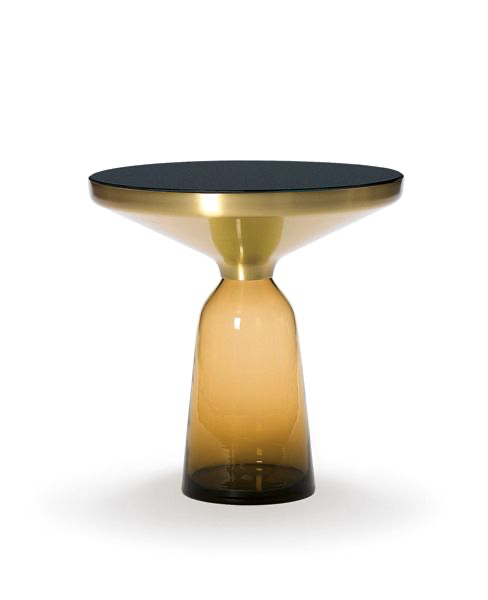
At first glance it is a simple inversion. A material normally read as light, thin and fragile becomes the base; a heavy metal top sits above it and seems to float. The tension between the two is the visual idea, and if that were all it was, it would be a nice trick.
It is more than a trick because the idea was treated as a production question as much as a design one. The glass base is hand blown in a wooden mould, which means no two bases are identical. Small bubbles, shifting thickness, minor irregularities: not defects to be sanded out but evidence of how the object was made.
That made it demanding to bring to market. It needed a manufacturer willing to commit to an unfamiliar construction, coordinate specialist production, and accept variation as part of the value rather than a fault to be controlled out. ClassiCon became that partner and launched the Bell Table in 2012.
The risk was never really that the glass might break. It was that the whole proposition depended on people accepting a different relationship to perfection: seeing a hand blown irregularity as character, and glass as structurally confident rather than merely delicate.
That is also why it is misleading to describe the table as a designer handing a drawing to a factory. Three parties made it exist. Herkner brought the question and the material direction. ClassiCon made it viable through production, quality control, distribution and warranty. Specialist makers turned the design into an actual object, and their skills and constraints fed back into the design itself. It is a negotiated object, not a delivered one.

Going to where the making happens
That negotiation became his method.
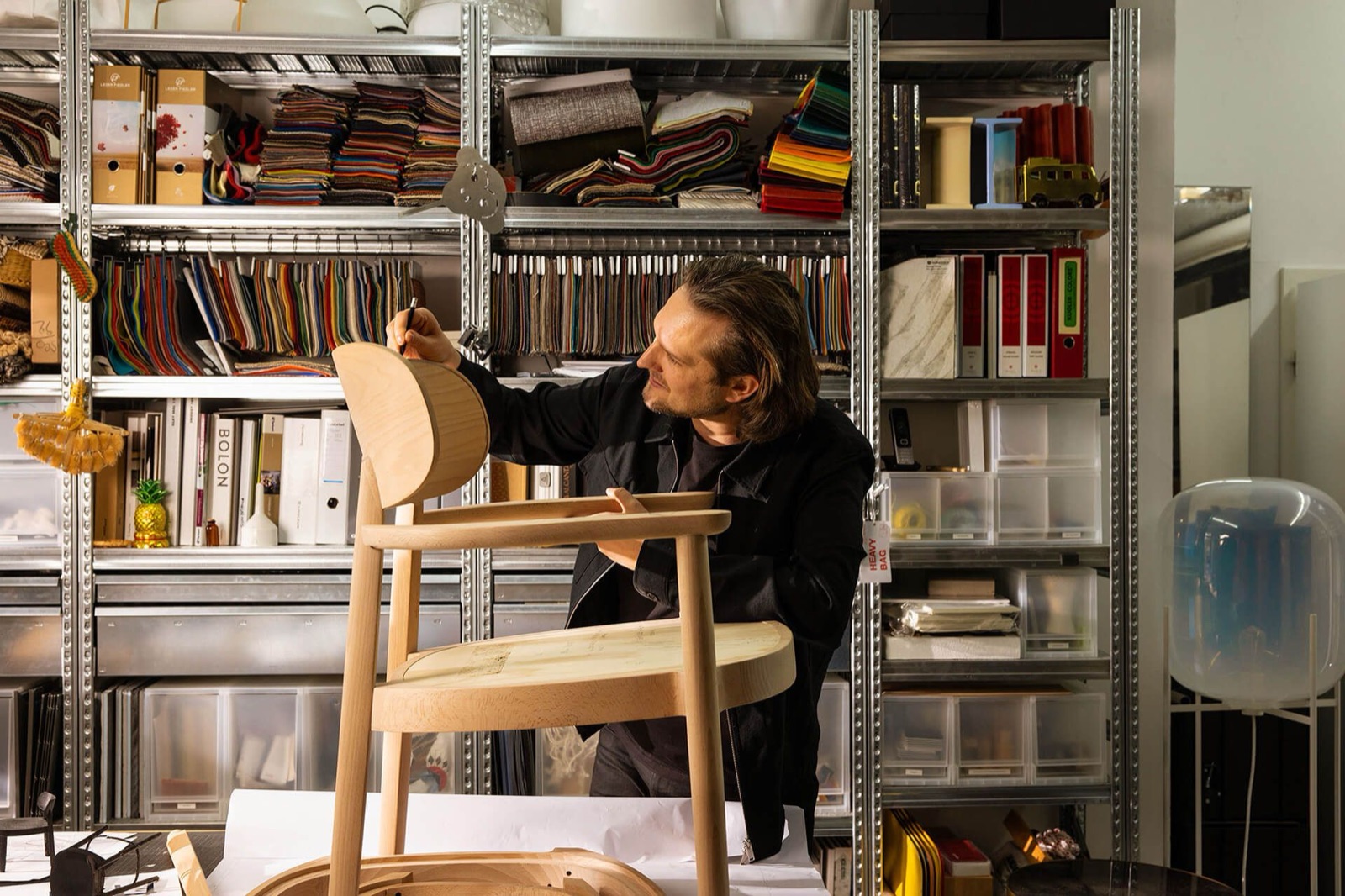
Herkner repeatedly describes visiting workshops and factories at the very start of a project, to see the people, tools, materials and accumulated knowledge behind a manufacturer. The visit is not ceremonial. It tells him what can realistically be made, and where a process has more in it than the company has yet noticed. For Herkner the specialist maker is not an anonymous supplier at the end of a chain. The maker is part of the design conversation.
It explains why his catalogue moves between apparently unrelated materials: woven fibre, hand carved timber, cast and blown glass, ceramics, bentwood. These are not visual themes chosen from a distance. They are ways of working that belong to particular places and people. The career reads less as a catalogue of styles than as a run of relationships with production.
From object to practice
The Bell Table broke through because it condensed all of that into one legible object. It looks sculptural, but it carries an argument about how furniture should be made: that traditional craft and contemporary design are not opposites, that a visible mark of handwork can be a value rather than a flaw, and that a manufacturer can take a real commercial risk on a process that refuses to deliver perfect sameness.
Those ideas matter more as a studio scales. Herkner now works across established manufacturers and has become a visible advocate for craft, material knowledge, and the communities that make objects possible. The public success is real, but it sits on an unusually patient way of working: returning to factories, listening to makers, and letting a material resist him.
Where the story might go next
This last stretch is a prompt rather than a claim about his plans.
The furniture industry is consolidating and growing more cautious about risk, which makes the conditions that let a young designer turn a hand blown glass experiment into a commercial product harder to reproduce. Herkner may matter increasingly as a bridge between two worlds: manufacturers that need commercially viable products, and the specialist crafts and regional material knowledge that quietly disappear when production is reduced to efficiency alone.
The next chapter may not be another iconic table. It may be a larger role in keeping difficult, slow, locally rooted ways of making both visible and economically possible.
The point
The apple sorter failed. The Bell Table did not.
The connection is not that a child failed and later succeeded. It is that the same curiosity carried straight through. Herkner kept asking how objects move, balance, carry weight and come into being, and over time those questions met the knowledge of craftspeople and the nerve of manufacturers.
That is how an unlikely structure becomes a piece of furniture.
Source notes
- Studio Sebastian Herkner, Bell Table - ClassiCon, Bell Table product sheet - Azure Magazine interview - Interior Design interview - Population figure: City of Bad Mergentheim