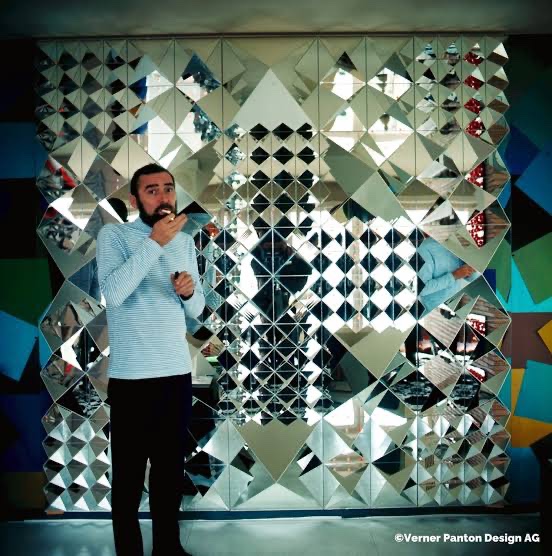
Verner Panton got the keys to his father's restaurant in 1958. Everything he ever did came out of that room.
There is a version of Verner Panton that circulates in shorthand: the plastics guy, the psychedelic one, the man who made the chair. It is not wrong so much as it is the last third of the story told without the first two. Panton would be a hundred this year (born 13 February 1926), and the centenary is a decent excuse to run the tape from the beginning, because the beginning is where the method comes from, and the method is the actual contribution.
It starts in a country pub on Funen.
The innkeeper's son
Panton was born at Brahesborg-Gamtofte on Funen, the island between Zealand and Jutland, the elder of two brothers. His father, Henry Panton, came from a farming family and worked as an innkeeper. Specifically, he held the tenancy of the Kom-igen guest house on the Langesø estate.
Two details from the childhood get flattened in most accounts. The first is that his parents separated when he was around ten. Verner stayed with his father, who went on to have three more children with his second wife. This matters later, because when the 1958 commission arrives it is his father's restaurant, not "his parents' inn", a distinction that Wikipedia and even some Vitra copy lose.
The second is the war. From 1944 to 1947 Panton attended Odense Technical College while doing military service, and in the final year of the occupation he had to go into hiding, having joined a student group resisting the Germans. It is in the family's own archive and it almost never gets mentioned.
There is a third, better loved story: that the young Panton wanted to be a painter, that his innkeeper father wouldn't have it, and that architecture was the compromise they reached. It's told widely, and it's a good story, but the official archive doesn't mention it at all, in either the childhood pages or the chronology. What is solidly attested is the softer version: Charlotte and Peter Fiell record that he was already an experienced artist in Odense before he reached the Academy. So: he painted seriously before he designed anything. The paternal veto belongs in quotation marks and at arm's length.
Two mentors, one of them overlooked
He took architecture at the Royal Danish Academy of Fine Arts in Copenhagen, 1947 to 1951. The Arne Jacobsen apprenticeship that follows is the one everybody cites. The more consequential relationship is the other one.
In 1950, still a student, Panton married Tove Kemp, the stepdaughter of Poul Henningsen. The marriage was brief and the couple lost a son in infancy, but the friendship with his former father in law ran another seventeen years, until Henningsen's death in 1967. The official archive names Henningsen as Panton's first and most significant mentor, explicitly ranking him ahead of Jacobsen, whom it files as the second major professional influence. In 1967, the year Henningsen died, Panton won the PH Prize, Denmark's design award named for him.
Nobody has written down the causal link between Henningsen's glare free, shade controlled lighting philosophy and Panton's own lamps, but you can see it without being told. The Flowerpot, the Panthella and the VP Globe all conceal the source and control the distribution. That is a PH argument executed in a different vocabulary.
The Jacobsen years ran 1950 to 1952, beginning while Panton was still enrolled. He worked mainly on furniture and contributed to the development of the Ant. Contributed to, not authored: the Ant is Jacobsen's. Why he left isn't documented. The standard reading is that he chafed at the Danish orthodoxy of wood and natural finishes, which is interpretation rather than record. What he did next is not in dispute.
The van
In 1953 Panton bought a Volkswagen van, converted it into a mobile drawing office, and drove around Europe in it, meeting manufacturers, dealers and other designers. The archive says the trips let him immerse himself in the international design world; in practice he was building the contact book that would carry the rest of his career.
Dezeen reports, and no one else corroborates, that Panton's first commercial design was a buttonless shirt, patented and sold to a shirt factory, and that the proceeds bought the van. Take it as unverified. It would be a wonderful origin if it held up.
What the travelling demonstrably did was convert him. He came back persuaded that wire, enamel, plexiglass, steel and fibreglass were the materials worth pursuing, and that the Danish craft tradition was a cul de sac for what he had in mind.
Fritz Hansen put two of his designs into series production in 1955: the Bachelor Chair and the Tivoli Chair, both now with Montana, the latter renamed Panton One. In 1956 came the S Chair, fourteen layers of moulded plywood, cantilevered, no back legs, no visible joints. Its production history is genuinely muddled. The archive has serial production running 1956 to 1965 with A. Sommer manufacturing and Thonet distributing, while most dealer and museum records date Thonet branded examples to 1965. "Designed 1956, brought to market by Thonet in the mid sixties" is the phrasing that survives scrutiny. (The claim that its curve derives from the human tongue turns up in Artsy without a primary citation, and should be treated as the folklore it probably is.)
Worth registering here, because it complicates the received account: the S Chair is plywood. So are the arguments about Panton and wood.
New addition · 24 August 2026
The All Round House
In 1957, the year before his father handed him the keys to Kom-igen, Panton designed and saw produced a project that is rarely mentioned in accounts of his career: the All Round House, a prefabricated weekend cabin built from wood and metal, produced in a small series. It could be disassembled, transported, and reassembled. It could, if required, be used as a garage.
What matters about the All Round House is not its scale. It is the thinking behind it. Panton designed the interior around what he called a Living Tower, a vertical structure that organised the small space from floor to ceiling. The house was a system before the word became a design cliché. Every element served more than one purpose. The structure came apart and went back together. The same instinct that would later hang fabric panels from a restaurant ceiling to subdivide a room without building walls was already present here: solve the problem with the least possible material, and make the solution reversible.
Kom-igen, 1958
Then his father handed him the keys.
Henry Panton gave his son complete freedom over a refurbishment of the Kom-igen interior and a new single storey extension: steel columns, glass façade, roof terrace. Panton took "complete freedom" at its word.
New addition · 24 August 2026There was also a practical reason for the extension. A tulip park nearby was drawing tens of thousands of visitors, and Kom-igen was in such high demand that the extra room became necessary.
He ran five different shades of red through the interior, intended to give it warmth, balanced against darker tones, with the lighter reds held back for the table linen and the staff uniforms. He broke up the main dining room with geometric patterned fabric panels hung from the ceiling, subdividing the volume into smaller units without building a single wall. He built custom ceiling lights from ring shaped reflectors, throwing red tinted light. And he designed a new chair for the room: the Cone Chair, upholstered in red. A folded sheet metal cone. No legs, no frame.
To understand the effect, you have to remember what Danish interiors looked like in 1958. His daughter Carin puts it plainly: "People must have come in and been stunned because nothing was really red in the 1950s." The local paper Fyns Social-Demokrat reported that year that the restaurant was so swamped with visitors the staff could barely cope. Dezeen has it that patrons nicknamed the place the Red Ruby. That's a single source detail, and a nice one if true.
Two things came out of that room, and both of them are the rest of his career in miniature.
The first is the method. Kom-igen is where Panton first treated floor, walls, ceiling, furniture, lighting, textiles and the clothes on the staff as one designed system. Not a room with good furniture in it, but a room in which nothing was left outside the design. Everything from Visiona to the Spiegel building descends from this restaurant. He would put the principle into words later: "Interaction with the setting is far more important than that with just a chair or any other object; a room, a colour, furniture, textiles and lighting must be considered as a whole." He built it before he articulated it, and he built it in his father's pub.
The second is a manufacturer. Percy von Halling-Koch came to the opening, saw the Cone Chair, and founded a company, Plus-linje, specifically to produce it. Panton reportedly showed the chair upside down at trade fairs to draw a crowd, and a related story has a Cone Chair in a New York shop window pulling enough of a crowd to stop traffic before it had to be removed. Neither anecdote carries a contemporary citation; both are repeated often enough to have hardened into fact, which is precisely why they're worth labelling.
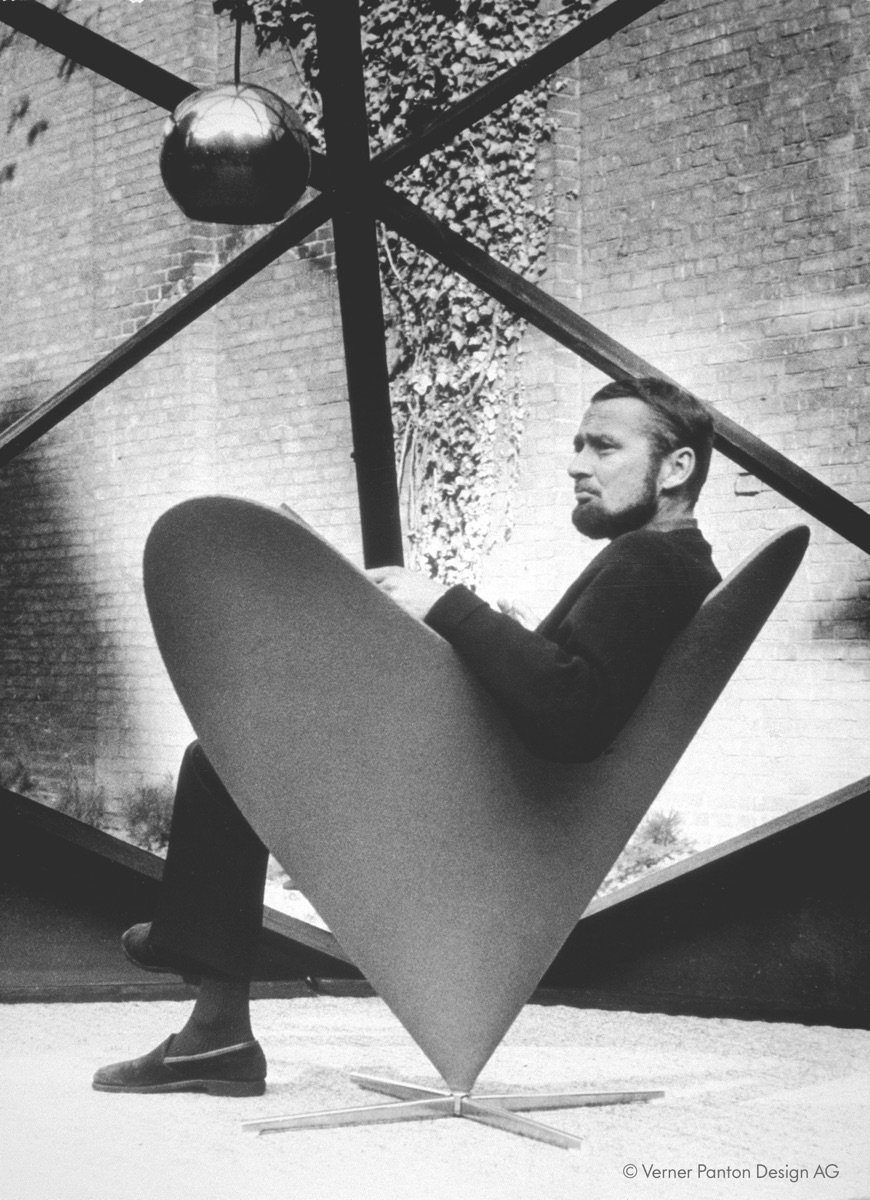
The Cone's logic, in Panton's own words, is the clearest statement of his whole approach: "If we were to start from scratch, a structure like a cone is much simpler than the four legged bistro chair standing over there." Primitives (cone, sphere, cylinder, S curve) weren't a look. They were structural first principles. Start from geometry instead of from inherited furniture typology and a different object comes out. The Cone works because folded sheet metal is rigid.
New addition · 24 August 2026
1960: the floating chair
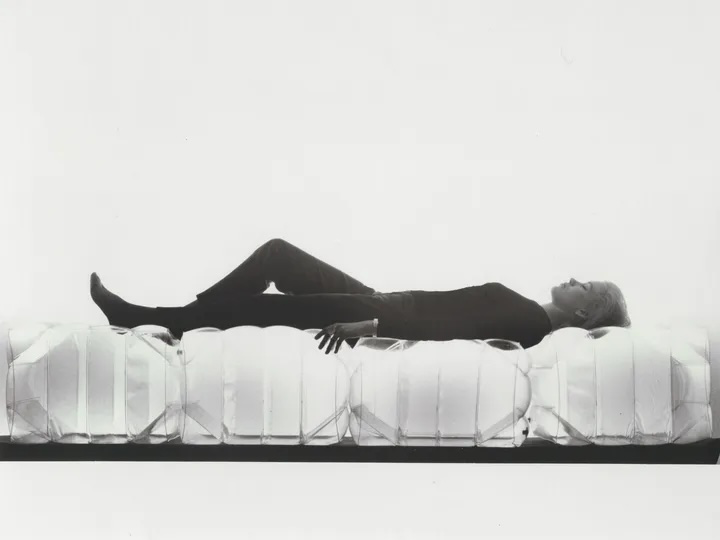
In 1960, two years before the Panton Chair prototype and four years before anyone would take the one piece plastic seat seriously, Panton designed what may be the most overlooked object in his catalogue: an inflatable stool of welded transparent plastic, commissioned for the Astoria Hotel in Trondheim. It is the first inflatable seating element in furniture history.
What it reveals is the direction his mind was already taking. Panton was thinking about how to make seating simpler. Not different, not decorative, but structurally reduced. The stool was a transparent cube, welded and inflated. No frame, no legs, no joints. You sat on air. The cubes were designed to be used individually or in multiples to create a lounge or daybed, which is the same systems thinking that would later run through his total environments. This was not a detour. It was part of the same inquiry. His experiments with plastic were as much about volume and air as they were about structure and cantilever, and the same instinct to strip away complexity was already driving the Panton Chair sketches. The stool comes back nearly sixty years later, on a Prada runway; that story is below.
The seven year no
The Panton Chair is the object the general public knows, and the received version of its story is upside down.
The precise claim is narrower than the legend: it is the first chair made from a single piece of a single synthetic material in a cantilever form. It is not the first one piece chair, and it is not the first mass produced one piece plastic chair. That's Helmut Bätzner's Bofinger, designed 1964 and launched in Cologne in 1966.
The chronology runs: explorations from the mid fifties, sketches in 1958 to 1959, a full size plaster model around 1959 to 1960. Then three years of rejection. Marianne Panton, his second wife: "We drove all over Europe with this chair: Milan, Cannes; we travelled far and wide in search of a manufacturer." Every one of them said it couldn't be made.
In 1963 Rolf Fehlbaum and Manfred Diebold went to see Panton after encountering a prototype that was, by all accounts, unstable, and talked Vitra's founder Willi Fehlbaum into backing it anyway. Panton, later: "Without Rolf there would have been no Panton Chair." Vitra's chief design officer Eckart Maise has described it as the biggest investment the company had ever made in a technology it didn't really understand. Ten prototypes and four years later, the chair appeared on the cover of the Danish magazine Mobilia, and a pilot series of 150 was produced in cold pressed glass fibre reinforced polyester. Not injection moulded: that comes much later, and getting it wrong is one of the most common errors in circulation.
Then the part that gets skipped. Production moved to Baydur rigid polyurethane foam (1968 to 1971), then to BASF's Luran S thermoplastic (1971 to 1979). And in 1979 Vitra stopped making it, because the thermoplastic version proved far less resistant to ageing and weathering than expected. The chairs were failing. It was produced in PU foam by Horn for the WK Group from 1983, and Vitra relaunched it properly in 1990. But the injection moulded polypropylene version, matte and dyed through and finally cheap, didn't arrive until 1999, a year after Panton died. The goal he'd been chasing since the mid fifties (an affordable chair for everyone, straight from the mould to large scale series) was reached without him.
One footnote for anyone tempted to cite scale: no cumulative or annual production figure for the Panton Chair has ever been published. Not by Vitra, not by the Vitra Design Museum, not in the fiftieth anniversary coverage. Vitra is privately held and doesn't disclose. Every number online is a modelled guess. The honest line is the more interesting one: nobody outside Vitra knows, and Vitra won't say.
Basel, and the total environment
Panton moved to Basel in 1963, for manufacturing rather than lifestyle: Scandinavian makers had told him the one piece plastic chair was impossible, and Vitra was willing to try. He'd met Marianne Pherson-Oertenheim in Tenerife in 1962 and married her in Basel in 1964; their daughter Carin was born there in 1966. In 1972 they moved to a villa in nearby Binningen, which he fitted out entirely in his own work as a living showroom. The room height living sculpture from that house is now in the Centre Pompidou.
The Basel years are the peak, and the through line from Kom-igen is unbroken.
Visiona. In 1968 Bayer commissioned an installation on a Rhine excursion steamer moored beside the Cologne fairground, intended to promote its Dralon synthetic fibre for home furnishing. Panton, in the archive's dry formulation, "found ways from the very beginning to get round any excessive restriction to the field of textiles," and designed the furniture and lighting as well. He called the results experimental interior landscapes in which colour and light played the dominant role.
Visiona 2 opened on 25 January 1970, same boat, same fair, and it is the one that made his name. His studio had a few months. The centrepiece, the Fantasy Landscape, was a cave like tunnel of roughly 50m² in violets and blues around a glowing red orange core, where floor, wall and ceiling flowed into one another with no clear transitions and no corners at all. Stern called it the definitive break with a thousand years of habit. The archive calls it one of the major spatial designs of the second half of the twentieth century. The Amoebe, the Spiral lamps, the Cheese tables, the Cloverleaf sofa and the first Mira-X collection all came out of it.
Der Spiegel, Hamburg, 1969. The magazine's headquarters: entrance, courtyard and lobby, canteen, bars, a staff swimming pool in the basement, conference rooms, corridor colour schemes. Everything was his own design (lamps, textiles, wall claddings), with only the furniture contractually obliged to come from Knoll. The offices themselves were left white, in deliberate contrast to the saturated communal spaces, which tells you the colour was doing programmatic work rather than decorative work. Panton on the building: "Each floor had its own colour scheme, its own hue appropriate to, psychologically supportive of, the work carried out on that floor." The pool burned. The lobby was redesigned in the nineties. But the canteen survived intact, and since Der Spiegel donated the surviving work in 2011 it has been a permanent installation at the Museum für Kunst und Gewerbe Hamburg. You can go and stand in it.
He ran the same argument again at the Varna restaurant in Aarhus in 1970 to 1971, giving each room its own colour scheme to articulate the existing structure of the building. Colour as analysis rather than decoration. Varna Palæet is still trading.
And the colour theory. Panton didn't merely like colour, he systematised it, and published on it: Lidt om farver / Notes on Colour, forty eight pages, through the Danish Design Center. "Choosing colours should not be a gamble. It should be a conscious decision." The clearest demonstration is Mira-X Decor I, developed for the Swiss textile company where he served as art director: eight pure colours, each in eight graduated brightness steps down to 15% saturation, five geometric motifs, each produced in three sizes in a 1:3:9 ratio. Either combine all eight base colours in one pattern, or run a single colour across its full scale. That is not a fabric range. That is a colour language with a grammar.
Which is also the correction worth making to the standard framing. Carin Panton pushed back on the plastics guy caricature earlier this year: "Throughout his career he worked in many different materials: glass, mirror, steel, wire, wood, textile, and enamel. His ideas were never shaped by substances." She includes wood, and she's right to. What Panton rejected wasn't timber. It was hand craft based small series production and the aesthetic of natural finish teak. No source records him disparaging Danish woodcraft in his own words; that's a curatorial characterisation, well supported by his practice but not by his quotes. The V&A adds a useful deflation to the plastics romance, too: the material wasn't chosen for futurism but for economics. Hand forming the Panton Chair in plywood would have cost a fortune.
The quiet decade
You can see the slump in the shape of the official chronology: dense entries every single year from 1960 to 1979, then near silence. Three causes are documented. The chair's material was failing. The oil crisis ended what one German design magazine calls the uncritical handling of plastic, and the stuff went from futuristic to embarrassing inside five years. And design taste turned to minimalism, in which Panton had no stake; the historian Daniella Ohad notes he "was certainly not considered collectors' material."
The story that usually gets told about this period (destitute, forgotten, broke) is not supported by any authoritative source. Not the archive, not Vitra, not the Vitra Design Museum, not Designmuseum Danmark, not Trapholt. Against it: he kept the Binningen villa, held a visiting professorship at Offenbach from 1984, and the awards never stopped. Germany's "Deutsche Auswahl" five times between 1981 and 1984, Denmark's Sadolin Farve prize and Germany's "Die Gute Form" in 1986, the Danish Design Council's annual prize in 1991. What stopped was the commissions, not the recognition. It's a better story anyway: not a forgotten man, a man the market had temporarily no use for.
New addition · 24 August 2026And in 1984 the slump took something permanent. Kom-igen was demolished.
The occasion was mundane. The extension had been built in a single winter to feed the crowds from Denmark's first flower bulb park, ten minutes away. When the park's attendance collapsed and it closed after the 1979 season, Kom-igen was left standing in a forest with nothing beside it. The inn and the ground had always belonged to the Langesø estate. Henry Panton only ever held the lease, so there was no family in a position to save it. In 1984 it was a redundant restaurant, and the question of whether the building in which Verner Panton invented the total environment might be worth keeping does not appear to have been asked by anybody.
It is also the only loss from these years that never reversed. Everything else came back. The room did not. What survives of the first place Panton treated floor, walls, ceiling, furniture, lighting and the clothes on the staff as one designed object is a handful of press photographs, shot by a Fyens Stiftstidende photographer on 8 May 1958, five days before it opened.
The turn came in 1990, when Vitra relaunched the Panton Chair. The museums followed: Danish Design Center in 1991, the Pompidou in 1992, Cologne in 1994 and 1995. He designed the Vilbert chair for IKEA in 1994, putting himself back into mass market retail. Commissions resumed from 1995, including the Swatch Art Clock Tower of 63 coloured rings for the 1996 Atlanta Olympics.
And in January 1995, British Vogue ran Kate Moss nude on a Panton Chair on its cover. That image is invariably credited with reviving him. It didn't: Vitra had relaunched the chair five years earlier. The cover was a symptom of the revival, not its cause, which is a more accurate observation and a more interesting one.
Twelve days
Verner Panton died in Copenhagen on 5 September 1998, aged 72. Earlier that year the Queen of Denmark had made him a Knight of the Order of the Dannebrog. (The cause of death isn't reliably established; the Swiss cantonal biographical lexicon says only that he died unexpectedly.)
His exhibition Lys og Farver (Light and Colour) opened at the Trapholt museum in Kolding on 17 September 1998, twelve days later. It was the last exhibition he designed himself: eight sequential rooms, each with its own colour scheme, demonstrating the effect of colour on mood. The archive calls it a representative cross section of his entire creation as a designer. He never saw it open.
Forty years after Kom-igen, the last thing he made was a sequence of rooms in which colour did the work.
New addition · 24 August 2026
The inflatable stool comes back
Going back to the inflatable stool from 1960: it remained a curiosity for decades. Verpan reissued it in 2017, and the following year Prada commissioned an exclusive run for its Spring/Summer 2019 menswear and womenswear shows in Milan. The menswear show, held on 17 June 2018 at Prada's Via Fogazzaro space, was set designed by AMO, OMA's research studio. The room was divided into a grid of squares marked with geographic coordinates, each square holding one of Panton's transparent inflatable stools, while the floor was covered entirely in industrial sheeting. Four longitudinal corridors were left open for the models to walk. The effect was described as psychedelic and uncanny, a sea of transparent cushions floating above an industrial plane. Each stool carried a VERPAN for PRADA inscription. After the show, the stools were offered for pre order through Prada's website at $850, packaged with a carry case and an electric inflating machine.
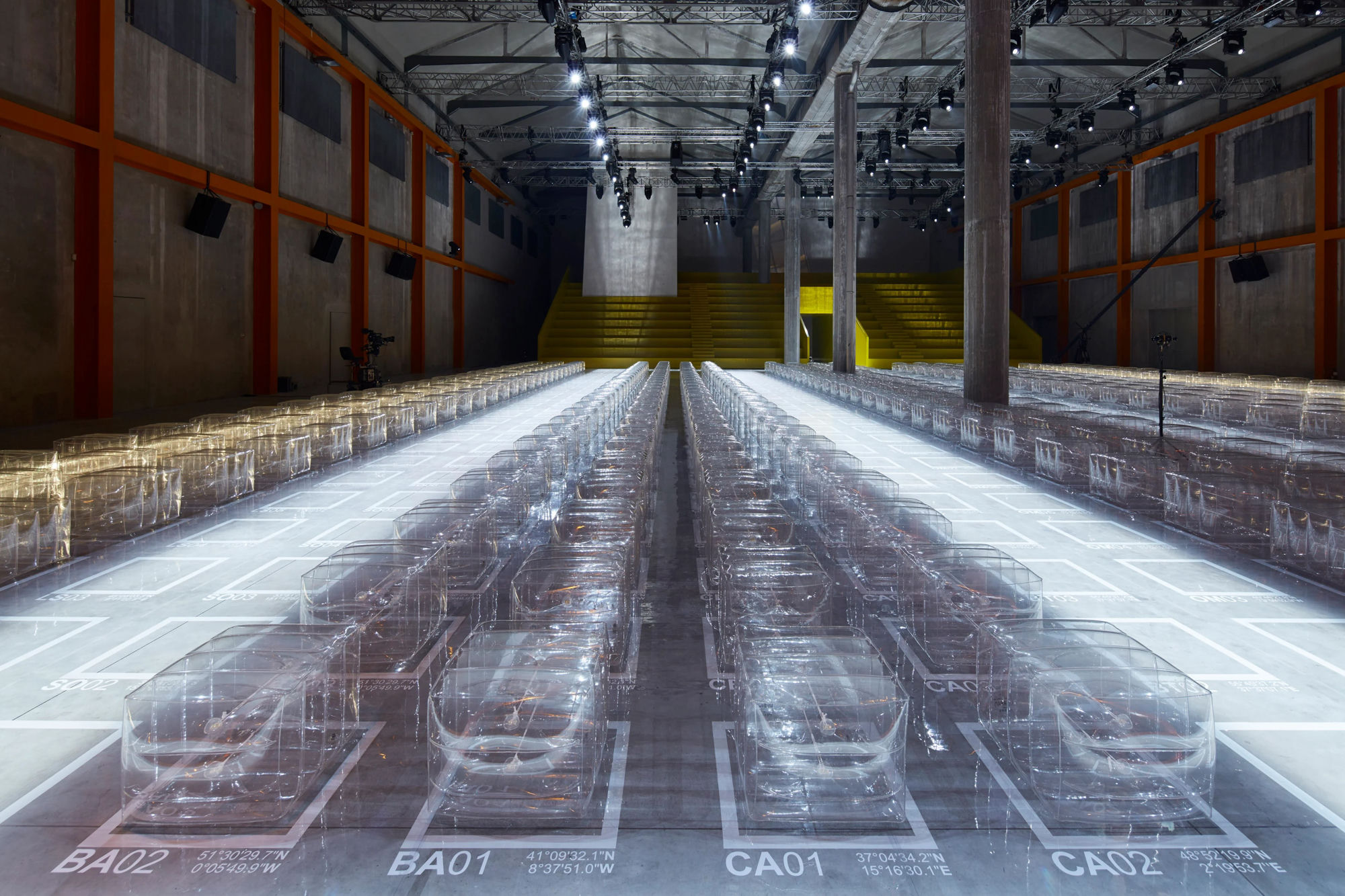
That it still looks futuristic in 2026 is a measure of how far ahead of its market it sat. The object from a Norwegian hotel lobby in 1960 walked a Milan runway nearly sixty years later. By the time Panton began sketching the Panton Chair in earnest, he had already made furniture from air.
The centenary
2026 is why every manufacturer on his licensing list has something out. Vitra's retrospective, Verner Panton: Form, Colour, Space, is open at the Schaudepot in Weil am Rhein until 9 May 2027, drawn from an archive of more than 40,000 documents, and its centrepiece is a full scale, walk in reconstruction of the Fantasy Landscape, built with Bayer. Vitra also put four colours from Panton's own interiors to a public vote and released a limited edition of 2,000 chairs in June, in the winning shades: Bold Orange, Flash Red, Electric Blue and Bright Turquoise.
Louis Poulsen has reissued the Panthella in its original seventies palette. &Tradition has added three colourways to the Flowerpot, taking the range to nineteen. Montana has reintroduced the Panton Table. And Fritz Hansen is selling Arne Jacobsen's Series 7 in the four colours Panton chose for the company's own centenary in 1972 (yellow, orange, red, brown), for this year only.
Which closes a loop worth pausing on. He started out in Jacobsen's office, making prototypes for someone else's chair. A hundred years after his birth, Jacobsen's chair is being sold in Panton's colours.
He would probably have found that funny. He'd have preferred you painted the room.