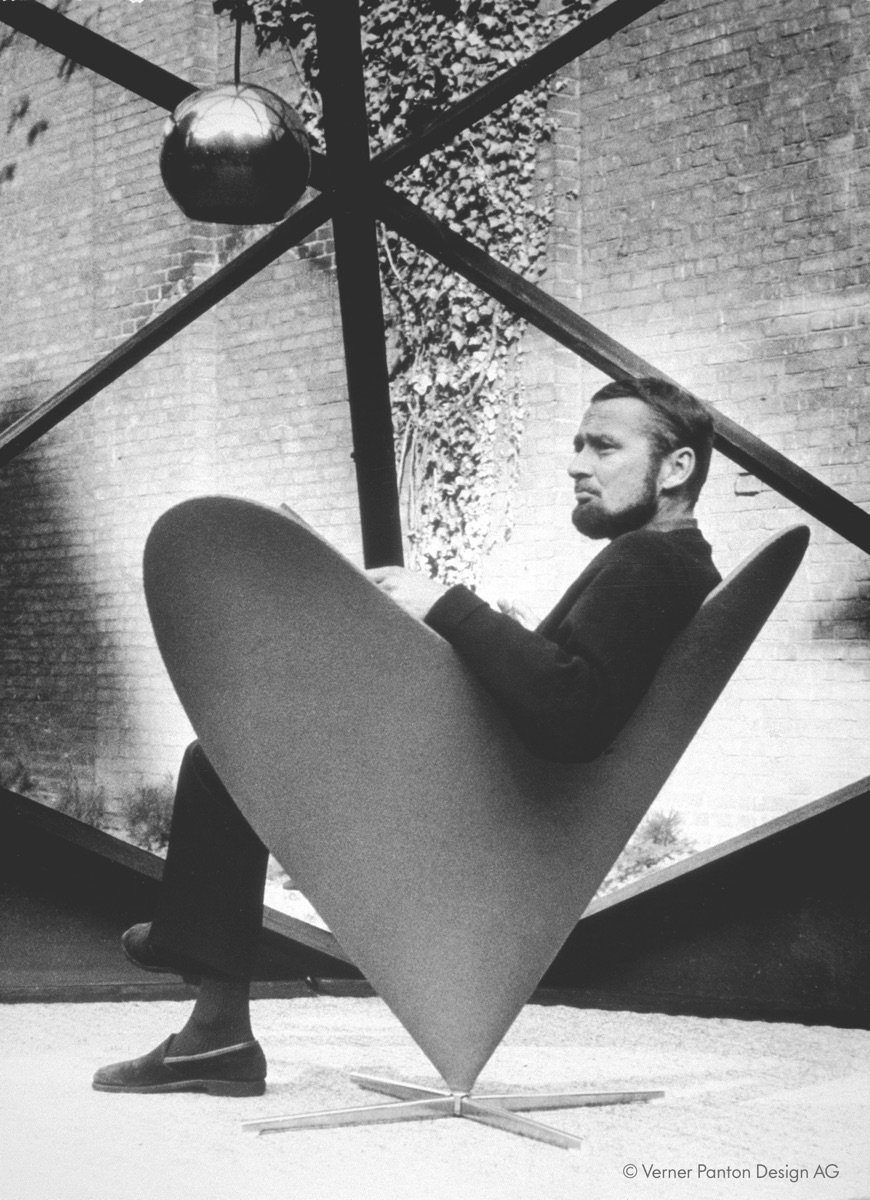
I went back over the Panton story after writing the main piece and kept pulling on one thread until it turned into its own. It starts, of all places, with tulips.
A tulip garden dreamed up in a sauna
In 1956 two men, a cemetery inspector and the local baron, came up with an idea in a sauna in Odense: to build Denmark's answer to Keukenhof, the Dutch bulb garden. They opened Langesø Blomsterløgpark in May 1958 with 300,000 bulbs from 28 growers spread over seven or eight hectares, and in its first 29-day season it pulled 71,000 people into a very quiet corner of North Funen.
The inn that needed an extension
All of those people needed feeding and housing. Panton's father held the lease on the Kom-igen inn beside the park, and he asked his son to design an extension. It opened on 14 May 1958, one day after the tulip park.
What Panton gave him was not really an extension. It was a statement, and the building ended up becoming part of his identity. He drew it himself, steel and glass with a roof terrace over the Langesø woods, then designed everything inside it as well. Five different shades of red across the whole interior, red nylon curtains, copper lamps and ceiling lights built out of rings that bounced the red light back into the room. Instead of walls he hung panels of geometric fabric to divide the space. He did the tableware, the menus and the staff uniforms too. The locals christened it Den Røde Rubin, the Red Ruby.
The chair that was part of the room
And then there are the chairs. He could not buy what the room needed, so he made it himself: the Cone chair, an upholstered cone balanced on its point. This is the part I find most interesting, because the Cone chair was not designed and then put into a room. It was designed as part of one. To Panton the chair, the light, the curtain and the colour were all a single object, and you could not really understand one without the other three.
And it worked. A man named Percy von Halling-Koch saw the chair at the opening and founded a company, Plus-linje, for the sole purpose of making it. Kom-igen also kicked off his work with Louis Poulsen on the lighting and Unika Væv on the textiles. One small restaurant in a field of tulips ended up setting up the next forty years of his career. There is also a good story that when a New York store put a Cone chair in its street window, drivers slowed so sharply to look at it that the shop was asked to move it further back.
The sad part
Then comes the sad part. The bulb park's crowds thinned out through the 1970s and it closed for good after the 1979 season, and without the tulips the inn had no real reason to be there. The Red Ruby was left to rot and it was pulled down in 1984. Panton's second complete work, the thing everything else grew out of, only stood for about 26 years. Only a handful of the original chairs survive, and just two of them are known to still wear their 1958 fabric.
Why it still matters to us
The principle Panton started with still carries into our work every day. A piece is rarely just a piece. It was drawn for a particular room, a particular light and a particular set of things around it. Our job is to get it there in one piece and then help it all come together, from helping customers choose the right piece for the space through to getting it to them and setting it up properly in the room.